Category: Detox

Yeah, I Love Heavy Metal – Just not in my Tomato Sauce

My journey to an aluminum foil alternative began inconspicuously enough: When I first opened this particular package of aluminum foil, it seemed fine. Perhaps it was because the lighting was bright or I just wasn’t paying attention. But when I went to wrap the dinner leftovers later that evening, I noticed a peculiar rainbow type pattern on one side of the foil. It was a smear that ran lengthwise on the roll. I thought that maybe it was too old or had somehow mildewed from being in the basement too long, which has a tendency to be damp. I unravelled the roll a few feet to try and find foil that looked more normal, but had no luck. Hurried, I chose to make sure that the weird looking side of the foil was facing away from the food, so it didn’t contaminate the food with whatever this stuff was.  Somewhere, I had heard that there was one side of the aluminum foil you didn’t want to have contact your food anyway. This became my modus operandi for the next few weeks. But, each time I handled the foil, I was irked by the blemish. Finally, I threw the box into the recycling garbage. I was pleased with myself for being willing to toss it out, for I’m usually one who doesn’t like to “waste” things.

As if I had been living a bad dream, when I opened the food wrap drawer to make school lunches the following night, that roll of tarnished aluminum foil was back in the drawer! Someone must have salvaged the foil out of the garbage. Ugh. Now, I had to throw the foil out a second time. Not wanting to make a habit of this, I buried the foil deep in the garbage so no one would dare go and get it out. Then, I turned the computer on and began researching aluminum foil. It turns out, after almost 70 years after this invention, it’s not a product you want to have routinely touch your food.

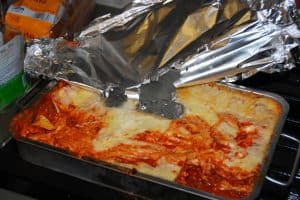
Foil is fine for a wrapping most cold dishes, as long as the food isn’t acidic. Wrapping a sandwich is fine. When aluminum is wrapped on food and heated, the foil releases tiny aluminum particles into the food it is protecting from drying out. Leaching also happens at room temperature when the foil is resting comfortably on an acidic food, such as tomato sauce. How many times have I not only wrapped my leftover spaghetti and sauce with aluminum foil, but then placed the dish along with the foil in the oven to reheat the meal?!

Aluminum is a heavy metal that is toxic to your nervous system. You don’t want to eat it. There is an association between aluminum and neurodegenerative diseases such as Alzheimer’s disease and Parkinson’s disease.

What to do?

Consider a useful aluminum foil alternative: unbleached parchment paper. I prefer the “If You Care” brand that uses silicone for a nonstick coating instead of other chemicals. It’s cheap, clean and it will provide an appropriate barrier between your food and your aluminum foil. Put your food in a Pyrex dish, CorningWare or a ceramic dish and first cover your food with parchment paper, and then wrap with foil. You can reheat your food in the oven with the parchment paper under the foil. It’s a simple solution to reduce your exposure to a common household toxic heavy metal.

See also: Avoiding household toxicity with The Radon Test Ruse.

No More Crispy Home Fries

Was it an act of defiance? Once again, I requested extra crispy home fries. This time though, I was secretly mired in conflict. I love my potatoes burnt to a crisp. But, after reading a recent scientific paper about the cancer causing effects of fried potatoes, I’m gearing up for yet another change in my diet.

To quickly summarize, the hazards of adding nitrates to food dates back to a Norwegian Mink farm in the 1950s, when animals began to suddenly die from liver disease and cancer after being fed a new diet of fish meal preserved with nitrites. It was soon discovered that the nitrites were being converted in the animal’s stomach to nitrosamines, sickening and killing the animals.

Both nitrates and nitrites are naturally present in many grains, fruits, and vegetables including celery, leafy greens and potatoes. Nitrates are converted to nitrites in the body. Nitrites are then chemically converted into either beneficial or harmful compounds. When nitrates are ingested in vegetables alone, they are usually turned into healthy nitric oxide which can have beneficial cardiovascular effects. But, when nitrates are combined with degrading proteins in the presence of high heat (cooking) or a strong acid (digestion), they form nitrosamines.

Nitrosamines are carcinogenic, associated with cancers of the esophagus, stomach, colon and rectum. Nitrosamines have also been associated with Alzheimer’s disease, Parkinson’s disease and type II diabetes. This is bad stuff.

Because nitrites/nitrates prevent bacterial growth, have a mild salty flavor and redden meat, food producers apply synthetic and natural occurring nitrates to chemically preserve meats and other foods. Your skillet, grill or broiler can become a perfect crucible for the production of nitrosamines when you cook hotdogs, bacon or sausage. To address this problem, manufacturers have significantly decreased the amount of nitrates they use and they add Vitamin C to processed meats, which inhibits nitrosamine formation.

Gratefully, the incidence of colon carcinoma is going down in this country. This is in part related to screening exams, but also likely due to the decreased concentration of nitrates added to processed meats. As of October 2015 though, colorectal carcinoma was still the 3rd most common form of cancer death in the US, so perhaps more changes are needed.

According to recent research by Qajarbeygi et al, it turns out that deep frying or pan frying potatoes produces nitrosamines too. Although the researchers didn’t test foil wrapped potatoes cooked on hot charcoals, I think this too would cause nitrosamine production.

It was previously believed that the potato skin contained all the nitrates so if you peeled the potato, you would remove them. But the potatoes were peeled in this study. Potatoes contain vitamin C, but apparently not enough to prevent nitrosamine formation.

What can you do?

1. Reduce your intake of processed meats and look for labels that specify no nitrates added. Even then, check the ingredient panel for celery juice or celery salt. Celery is a source of nitrates and the chemical effect is the same.

2. Reduce consumption of other foods containing nitrosamines, including beer, artificial cheese, smoked and salted fish.

3. Boil or bake your potatoes and sadly say goodbye to crispy home fries.

Create Your Home Consciously

Writing is not new to me, but blogging is another story. I’ve written many scientific papers and a couple of book chapters in the medical literature. Writing non-fiction however has been calling to me for some time now, for I have a lot to share for those interested in learning from my experiences. I am a diagnostic radiologist who for the past decade, has been working and living in a Pittsburgh suburb, helping to raise my two children. Read More